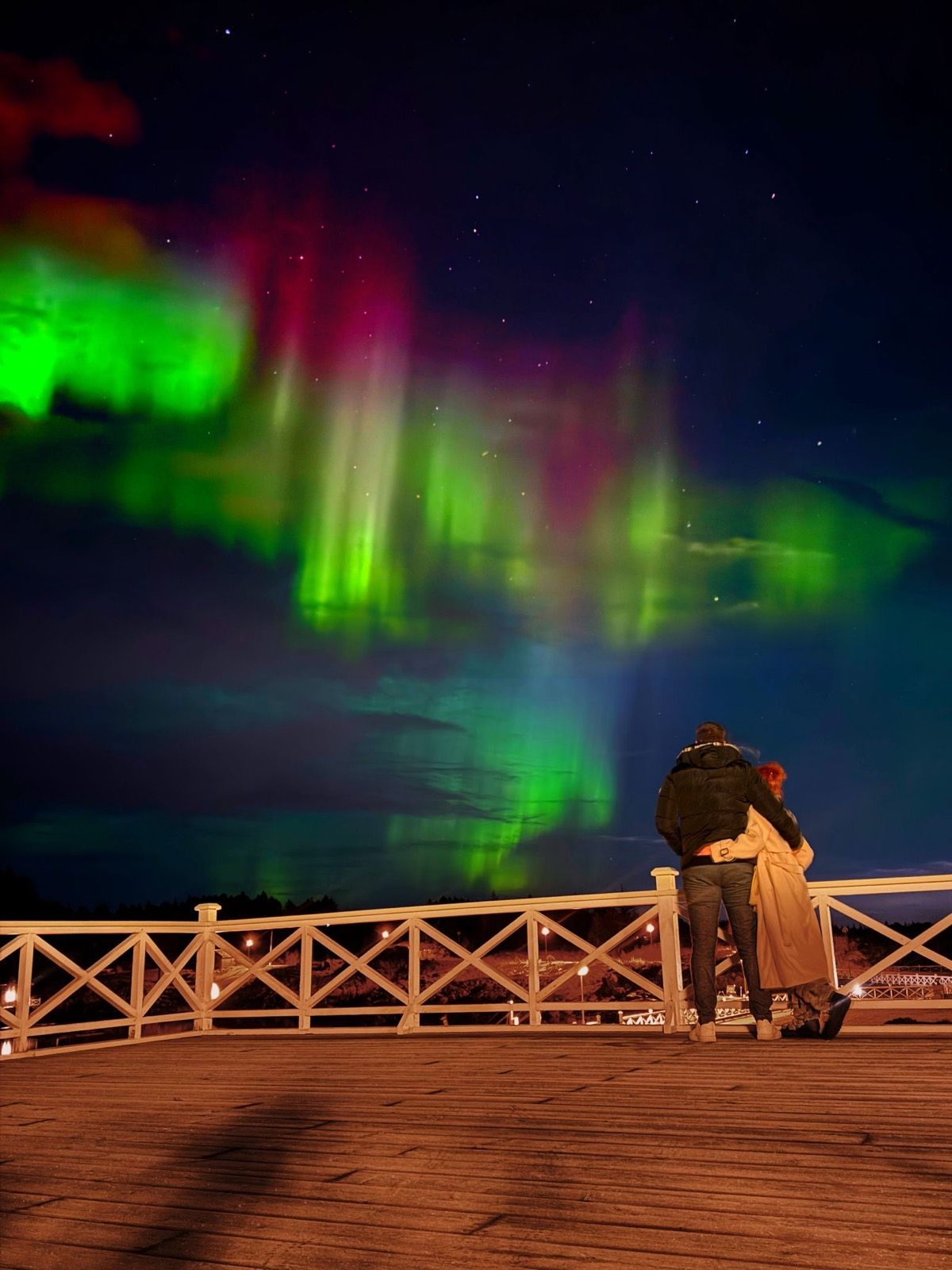
Yes, the aurora is visible from Averøy, and you do not need a tour to see it. But we are three and a half degrees south of the Arctic Circle, which means we need a stronger night than Tromsø does — and the limiting factor here is almost always cloud, not activity.
Last updated 14 August 2026
The honest version
Can you actually see it here?
Yes — and the photograph at the top of this page was taken from the coastline in front of the house, not borrowed from a stock library.
But it is worth understanding the geography. The aurora is not spread evenly over the sky; it sits in a ring around the magnetic pole, and that ring normally hangs over northern Norway. Tromsø, at 69°N, is under it. Averøy, at 63.08°N, is south of it. On a quiet night the aurora is up there being watched by somebody in Tromsø, and here the sky is black.
What happens on an active night is that the ring expands southwards and reaches us. Then it is visible — often as a green arc low across the northern sky, sometimes overhead and moving, occasionally the full curtain. That is a normal several-times-a-month event in the season, not a rarity. It is simply not a nightly one.
When to come
The aurora happens year-round; it is only visible when the sky is dark enough, which here means late September to late March. In June there is no darkness to see it in, regardless of what the sun is doing.
Within that window, the equinox months are the best: September, October, February and March. This is not folklore — geomagnetic activity genuinely peaks around the equinoxes, and those months also give you milder nights and less cloud than midwinter. The classic mistake is to book late December because it is the darkest; it is also frequently the cloudiest.
Most displays here happen between about 21:00 and 01:00. Set an alarm and check the sky rather than sitting outside all evening.
What actually decides your odds
Three things have to line up, and only one of them is about the sun.
- Darkness. Sorted, from late September. Ekkilsøy has very little light pollution — the nearest real glow is Kristiansund, and it is behind you when you face north.
- A clear sky. This is the one that decides your trip. We are on an exposed Atlantic coast and cloud is the default. A strong aurora above solid overcast is invisible, and no forecast app changes that.
- Enough activity. Because we are south of the oval, we need a more active night than the far north does. The forecasts worth watching are NOAA's 30-minute forecast and, for cloud, yr.no.
The practical consequence: come for at least four or five nights. A two-night stay in February is a coin toss weighted against you. A week in October usually produces at least one good night, and often two or three.
Where to stand
You do not need to go anywhere. The property faces north-west across open water, the terraces run around the buildings, and the jetty gives you an unobstructed horizon with the sea in front of it — which is what you want, because water doubles the display.
Two of the homes make that easier: the Aurora Suite is named for these nights, and The North Loft sits highest in the house with the widest windows facing north.
Step outside, let your eyes adapt for ten or fifteen minutes without looking at a phone, and face north. A weak aurora looks like a pale grey cloud that will not move with the others; your camera will show it as green before your eye does. If it strengthens, the colour arrives.
Dress for standing still in a wind off the Atlantic. It is a different cold from walking-around cold, and it is the reason most people give up ten minutes before the good part.
How to photograph it
A modern phone will get something. A camera on a tripod will get the photograph.
- Tripod, always. Exposures run to several seconds; nothing handheld survives that.
- Manual mode. Start at ISO 1600, f/2.8 (or the widest your lens opens), 5 seconds. Adjust the shutter down as the display brightens — a fast-moving curtain smears at 10 seconds.
- Manual focus on infinity. Autofocus hunts in the dark. Focus on a distant light before it gets fully dark, then tape the ring.
- Shoot raw and turn off long-exposure noise reduction, which doubles your shot interval for little gain.
- Put something in the foreground. The jetty, a boat, the red boathouse. An aurora with no landscape under it is a green smear; with a foreground it is a photograph.
And keep a spare battery inside your jacket. Cold flattens them in about half the usual time, always at the moment the sky opens up.
Keep reading
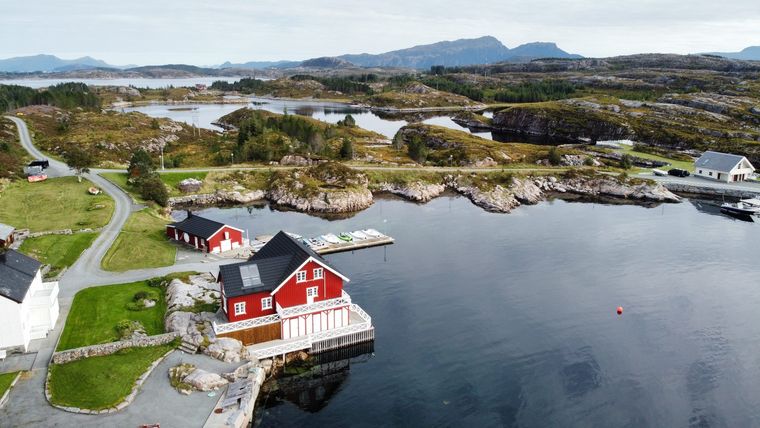
The best time to visit
What each month on this coast actually gives you.
Read the guide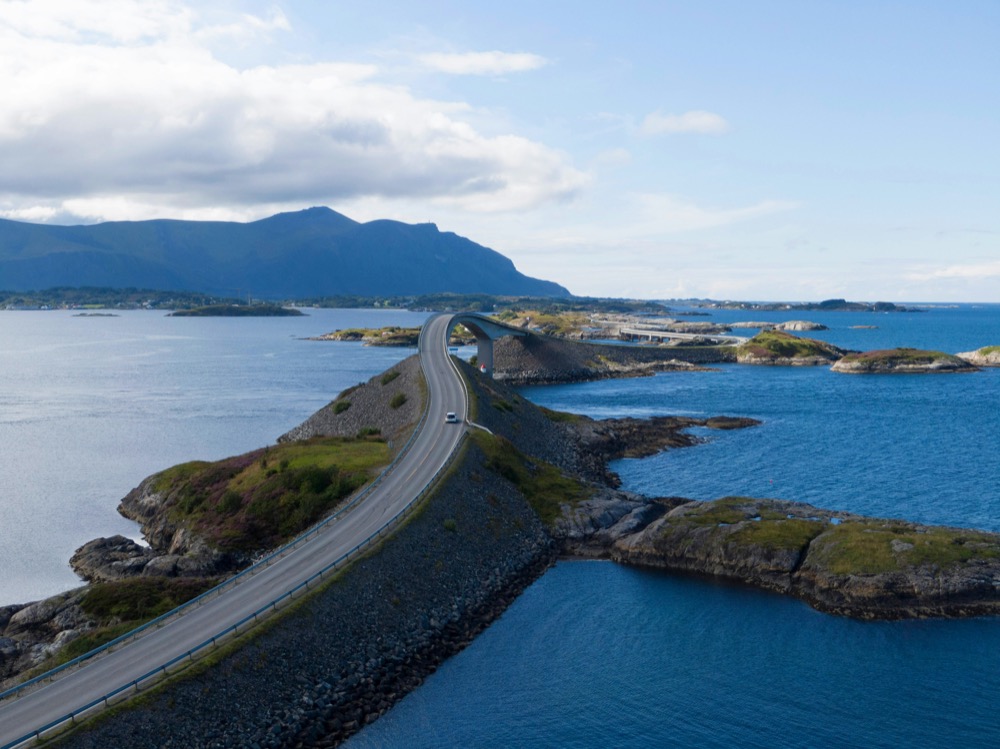
Is the Atlantic Road open in winter?
It never closes for snow — but storms are a different question.
Read the guide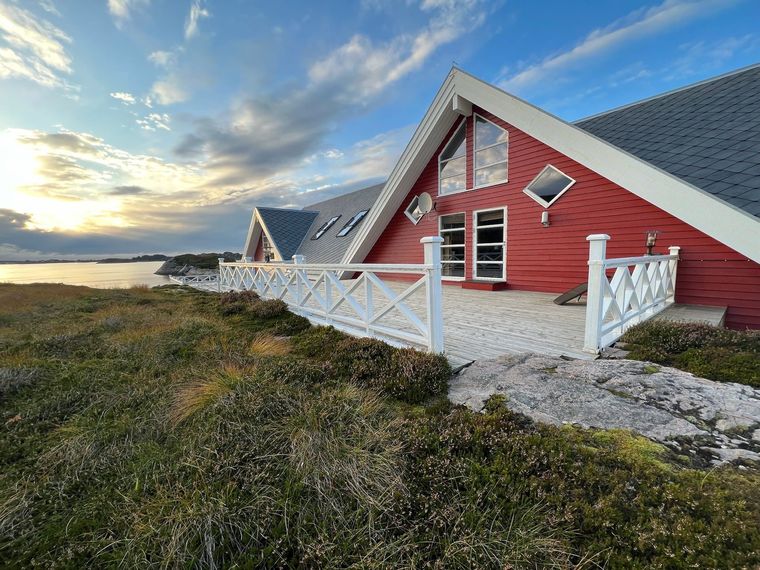
Getting to Averøy
Airports, the tunnel, and the toll that appeared in May 2026.
Read the guideEvery experience starts from your doorstep.
Five homes on Ekkilsøy, minutes from the Atlantic Ocean Road — with the Northern Lights in winter and light that never quite leaves the sky in summer. Book directly with us for the best welcome.
Check availability